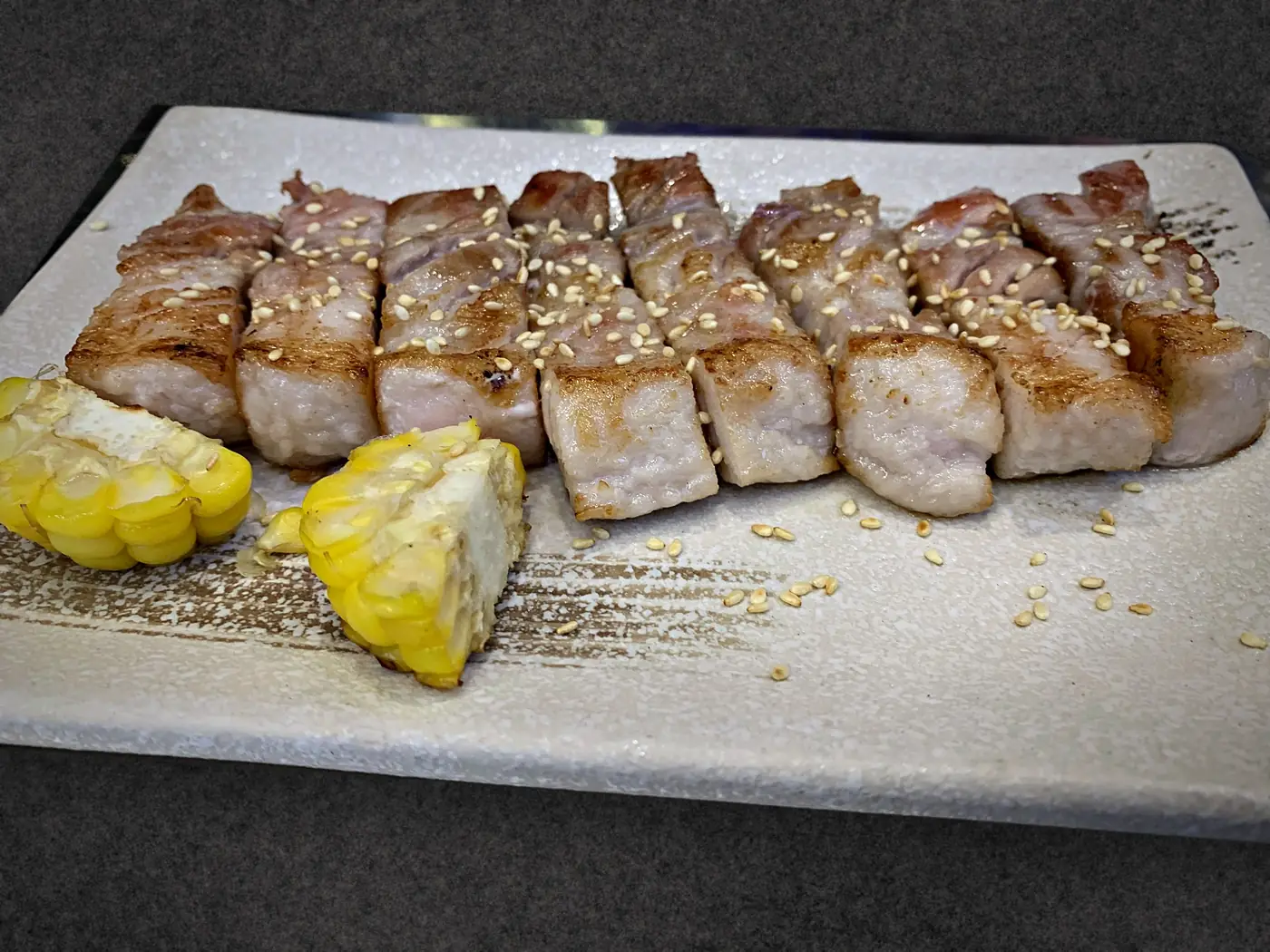
In Vietnam, Korean BBQ instantly brings pork belly to mind. But for Koreans themselves, samgyeopsal (삼겹살) is more than a dish: it is the after-work team dinner, the weekend get-together with friends, the “soul food” as the Korean press still calls it. Gogizip went through Korean-language articles and data from 2026 and summed up 8 interesting facts below, along with the view from a Korean BBQ restaurant in Phu My Hung.
1. The name “samgyeopsal” means “three-layer meat”
삼 (sam) means “three”, 겹 (gyeop) means “layer” and 살 (sal) means “flesh”. The name describes exactly what a slice of pork belly looks like: layers of lean meat and fat stacked on top of each other. That is also why Vietnamese call it “ba chỉ” (literally “three lines”) — two languages, one way of seeing it.
2. Pork belly is the most loved cut of pork, and grilling is the most popular way to eat it
According to data from the Korea Rural Economic Institute (KREI) quoted by Korean newspapers, about half of the meat each Korean eats is pork. Among pork cuts, belly ranks first in preference, and grilling accounts for about 62.5% of cooking methods. In other words, the picture of “the whole table gathered around a grill of pork belly” really is the most typical Korean meal.
3. 85% of Korean adults say they like samgyeopsal
A survey by Nonghyup (the National Agricultural Cooperative Federation of Korea), cited again by the Kyungbuk Maeil newspaper in 2026, found that about 85% of adults like samgyeopsal, and about 70% eat it at least once a week. Few dishes have such wide reach.
4. Koreans even have a “Samgyeopsal Day”: March 3
Because “sam” means 3 and March 3 has two 3s “stacked” together, Nonghyup chose this date as Samgyeopsal Day in 2003 to encourage consumption of domestic pork. Every year around this day, supermarkets and convenience stores across Korea cut the price of pork belly.
5. Each generation chooses its BBQ restaurant by different criteria
Korean livestock industry media have noted a fairly clear trend:
- In their 20s–30s: they love new experiences — unusual pairings, beautiful presentation, restaurants with their own concept (camping style, subway station, old hanok house).
- In their 40s–50s: they prioritize flavor, meat quality and service.
- Over 50: they choose fresh meat and a familiar, comfortable setting.
So when going out for BBQ with a multi-generation group (for example a family with grandparents and young children), it is best to pick a place that has both good meat and a variety of side dishes so everyone finds something they like.
6. “Aged” pork belly is a premium trend
In Korea, many BBQ restaurants upgrade their pork belly by aging the meat — wet aging (the meat rests in vacuum-sealed bags) or dry aging (the meat rests in a cabinet with controlled temperature and humidity). Aged meat is usually more tender and more flavorful. It shows how an “everyday” dish can still be taken in a premium direction.
7. A samgyeopsal table has more on it than you might think
A Korean agricultural newspaper once listed what usually comes with a table of pork belly: lettuce and Korean perilla leaves (kkaennip) for wrapping, garlic, chili, pickles, ssamjang and doenjang pastes, plus soju and beer. In spring, Koreans also love pork belly with water dropwort (minari). That is why wrapping meat in greens — called ssam — is not just tasty but also makes the meal more balanced, as the greens and garlic cut through the richness of the fat.
8. In Korea, a restaurant serving of pork belly is often only 150–180g
According to Insight (Korea), a single serving at pork belly restaurants today is often only about 150–180g, down from 200–250g many years ago, while the price of a serving has risen to about 15,000–18,000 won. Rising pork prices have also led many Korean families to buy meat and grill it at home. More interestingly, in 2026 the Korean government even gave a dedicated name, “doncharol” (돈차돌), to pork belly with too much fat, after many arguments about “all-fat pork belly” on Korean social media.
Eat samgyeopsal the Korean way in Phu My Hung
Want to try pork belly the way Koreans eat it without flying to Seoul? At Gogizip BBQ (93 Phạm Văn Nghị, Phu My Hung, District 7), pork belly (ba chỉ heo, samgyeopsal) is charcoal-grilled right at your table and served with 9 free banchan, lettuce wraps and dipping sauces. For two people, you can order Combo A (400g of pork: belly, neck and shoulder) to taste several different cuts, just like Koreans often order “a little of everything”.
- See our charcoal-grilled pork belly
- What is samgyeopsal? How to grill and eat Korean pork belly
- How do the different Korean BBQ pork cuts compare?
- BBQ in District 7: which cuts to order?
Frequently asked questions
Are samgyeopsal and pork belly the same thing?
Yes. Samgyeopsal is the Korean name for pork belly, literally “three-layer meat”. The difference lies in how it is eaten: Koreans usually cut it into thick slices, grill it at the table and wrap it with greens, garlic and ssamjang.
When is Samgyeopsal Day?
March 3 every year. Nonghyup chose this date in 2003 because “sam” means 3 in Korean.
What do Koreans eat pork belly with?
Most commonly lettuce, Korean perilla leaves, garlic, chili, pickles, ssamjang or doenjang, with soju or beer. Some people also like to add grilled kimchi or water dropwort.
Sources (in Korean)
This article was compiled and rewritten by Gogizip from information in the following sources; the original content is copyrighted by the respective publishers:
- Livesnews – samgyeopsal consumption trends by age, KREI data
- Kyungbuk Maeil – “The samgyeopsal that brings people together” (06/2026)
- Insight – Samgyeopsal Day, March 3
- Insight – pork belly portion sizes and prices at restaurants
- Insight – the name “doncharol” for overly fatty pork belly
- KREI – what goes with a samgyeopsal table
Craving Korean BBQ? Gogizip BBQ – 93 Pham Van Nghi, Phu My Hung (District 7), open 11:00–23:00 daily. Combos for 2 from 599k VND, for 4 from 1,159k VND (prices before 10% VAT). 9 free banchan, refilled anytime. Some of our staff speak English.