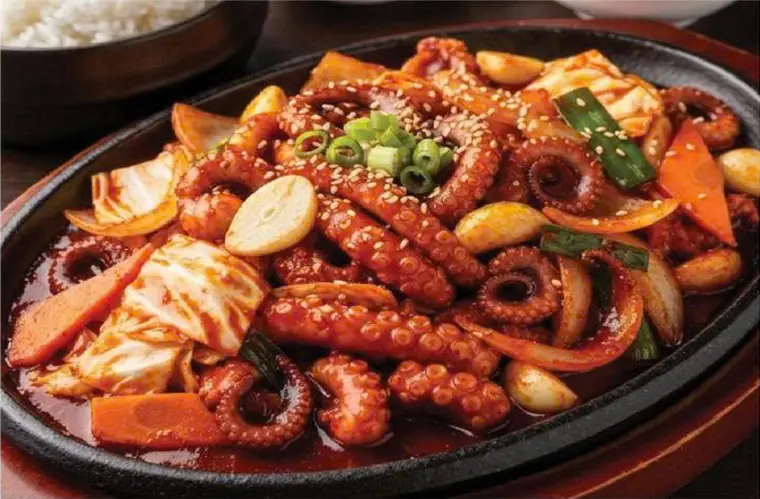
Korean spicy stir-fried octopus (nakji bokkeum, 낙지볶음) is a seafood stir-fry in a blazing red gochujang sauce, fiery, deeply sweet, and garlicky, so good with white rice or wrapped in greens that you will wipe the plate clean. In Korea, nakji bokkeum is famous as a “spice challenge” and also a beloved stress-relief food. For Vietnamese diners, octopus is no stranger thanks to grilled, stir-fried, and hot pot dishes, so the Korean version easily wins people over. This article explains what nakji bokkeum is, how to eat it, and why it has become such a favorite.
What is nakji bokkeum?
Nakji is a type of small octopus (long-legged octopus), and bokkeum means stir-fried. Nakji bokkeum is small octopus stir-fried with vegetables in a sauce of gochujang chili paste, gochugaru, garlic, onion, and scallions, and usually carrots, cabbage, and purple onion as well. The octopus is stir-fried quickly over high heat to keep it crisp and chewy, while the sauce clings evenly, forming a glossy red coating.
This dish is famous for its strong heat, but the heat in nakji bokkeum is not a simple harsh burn; it has a mellow sweetness and a light smokiness from the high-heat stir-frying. When you eat it, the first sensation is the fiery kick, followed by the sweetness of the seafood and a garlicky aftertaste.
Origins of the dish
Small octopus has long been a familiar ingredient in coastal regions of Korea, especially Mokpo and Muan in the southwest. Locals prepare nakji in many ways: raw (sannakji), in hot pot (nakji jeongol), and spicy stir-fried (nakji bokkeum). The spicy stir-fried version became popular nationwide thanks to its bold flavor that goes easily with rice. In big cities like Seoul, nakji bokkeum is usually served at seafood restaurants, with rice and steamed eggs to soothe the heat.
Octopus in Vietnamese and Korean cuisine
Vietnamese diners often eat octopus grilled with satay, steamed with ginger, in thinly sliced hot pot, or stir-fried with sweet-sour pineapple. The flavors lean sweet-sour, satay, or fish sauce. Koreans prefer spicy stir-fried octopus or octopus in hot pot, seasoned with gochujang, garlic, and sesame oil. What they share is that both cuisines value the crisp freshness of octopus, avoiding overcooking that makes the meat as tough as rubber.
The difference lies in the sauce: gochujang has a fermented, mellow sweetness and umami, giving a depth that Vietnamese satay does not. So if you have eaten Vietnamese-style octopus, try nakji bokkeum to experience the same ingredient through a completely different lens.
What is the difference between small and large octopus?
Nakji is a small octopus, with a body about a hand’s length, soft and sweet flesh that suits quick stir-frying. Large octopus has thicker flesh and needs longer boiling or braising to become tender. When stir-fried spicy, small octopus stays crisp without complicated preparation. At restaurants, chefs usually cut the octopus into bite-size pieces before stir-frying so it is easy to pick up and soaks up the sauce evenly.
Flavor and texture
- Bold heat: gochujang and gochugaru sauce create a fiery heat with a lingering finish.
- Natural sweetness: fresh octopus gives a clean sweetness.
- Garlic and scallion aroma: a rich fragrance as it is freshly stir-fried.
- Crisp and chewy: octopus stir-fried at the right heat is crunchy and chewy, never hard as rubber.
Secrets to crisp, delicious stir-fried octopus
The first secret is to stir-fry quickly over high heat. Octopus is rich in protein, and if stir-fried for long, it shrinks and turns tough. Just stir-fry for about two to three minutes until the octopus curls, changes color, and the sauce clings evenly. The second secret is thorough cleaning: the octopus must be washed with coarse salt, flour, or starch to remove slime, then rinsed clean several times. The third secret is seasoning the sauce just right: the sauce should be bold but not too salty, since octopus releases water when stir-fried.
In addition, stir-fry the vegetables first for a bit to keep their crispness, then add the octopus last. Finally, drizzle a little sesame oil and sprinkle toasted sesame to make the dish more fragrant. These details explain why restaurant nakji bokkeum is usually better than homemade: the chef controls the heat and timing very precisely.
How to eat spicy stir-fried octopus the proper way
- Eat it hot: cooled octopus turns tough and loses its aroma.
- Eat with white rice: hot rice neutralizes the heat and rounds out the flavor.
- Mix the leftover sauce with rice: the red sauce left on the plate, mixed with rice and seaweed, makes an extremely good meal.
- Wrap in lettuce: a piece of octopus, a bit of rice, and a lettuce leaf, wrapped and eaten.
- Pair with steamed eggs or soup: to soothe the heat.
Spicy stir-fried octopus in a BBQ meal
A BBQ meal usually leans toward meat, and spicy stir-fried octopus is a great change of pace. Bold spicy seafood refreshes the palate after rich cuts of meat. Pairing suggestion: Spicy Stir-fried Octopus, Steamed Eggs, and Pork Belly. You can read more about steamed eggs in the article Korean steamed eggs.
Different ways to enjoy nakji bokkeum
With white rice
This is the most popular way. A spoonful of hot rice, a piece of octopus, and a little red sauce. The rice absorbs the heat and mellows it, while the rich flavor of the sauce turns a bowl of rice into a main dish.
Wrapped in lettuce or seaweed
Use lettuce leaves or seaweed to wrap the rice and octopus into a neat little roll. This balances the heat, adds the cool crunch of greens, and suits people who like to eat light.
Mixed with noodles or glass noodles
In some places, spicy stir-fried octopus is eaten with noodles or glass noodles that absorb the sauce, making a spicy noodle dish. If you like cold noodles, read the article Korean cold noodles to choose a suitable end-of-meal dish.
With banchan
Kimchi, pickled radish, and seasoned vegetables all add variety. Learn more about banchan in the article what is banchan.
Tips for reducing the heat
- Eat with soft steamed eggs, milk, or yogurt.
- Eat plenty of white rice with each bite.
- Wrap with lots of fresh greens.
- Limit continuous iced water; switch to warm water or milk.
Arranging a meal with spicy stir-fried octopus
A fiery dish should be placed at the right moment. If ordered too early, you will struggle to taste the dishes that follow. If ordered too late, you may already be full. A sensible order is to start with a light appetizer, grill meat for a few rounds, then order the spicy stir-fried octopus in the middle of the meal to refresh your palate. Order with white rice or steamed eggs for balance.
If you come in a group of four or more, you can order one portion of spicy stir-fried octopus for the whole table to try, then order more if you like. Group combos such as Combo B or Combo D can be paired with a portion of spicy seafood for a richer meal.
Spicy stir-fried octopus and drinks
Cold fizzy soda, iced tea, or drinkable yogurt all help soothe the heat. For adults, cold beer is a popular choice, but drink in moderation. Avoid strong liquor with fiery dishes, since it easily irritates the stomach.
Nutrition of octopus
Octopus is rich in protein and low in fat, providing vitamin B12, iron, and zinc. However, a spicy stir-fry usually contains plenty of oil, salt, and sugar, so the calories and sodium are higher than boiled octopus. People who need to control blood pressure, blood sugar, or cholesterol should eat a moderate amount.
Things to note when eating octopus
Octopus must be thoroughly cooked. People with seafood allergies should not eat it. With a fiery dish, people with stomach problems should limit it. Children should not eat overly spicy food. Choose a reputable restaurant with fresh ingredients and clean preparation.
Who is spicy stir-fried octopus for?
This dish suits people who like spicy food, love seafood, and enjoy bold dishes with rice. It is not suitable for small children, people with weak stomachs, or those who cannot eat seafood. For groups of friends, it is a laugh-inducing dish because everyone gasps from the heat. For couples, a small portion to share, ordered with steamed eggs, is reasonable. For families, choose a moderate spice level or order an extra mild dish for the children.
One thing worth noting is that everyone’s perception of heat is very different. Some people eat spicy food easily, while others turn red after one bite. Respect your own limits and don’t pressure others. A fun meal is one where everyone feels comfortable.
Common misconceptions about spicy stir-fried octopus
- All octopus is chewy: in fact, whether it is chewy or crisp depends on the cooking method and freshness.
- Spicy food is hard to eat: with rice, egg, and greens, spicy dishes are very manageable.
- Only Koreans can eat it: Vietnamese people already love spicy food, so many find it suits them.
- Spicy stir-fried seafood can’t be combined with grilled meat: in fact it is a combination that makes the meal more varied.
Frequently asked questions about spicy stir-fried octopus
What is nakji bokkeum?
It is small octopus stir-fried with vegetables in Korea’s fiery gochujang sauce.
Is spicy stir-fried octopus very hot?
The dish is usually fairly hot. Newcomers should eat it with rice, steamed eggs, or milk to soothe the heat.
What do you eat spicy stir-fried octopus with?
With white rice, wrapped in lettuce, alongside steamed eggs or soup.
Is octopus chewy?
If stir-fried at the right heat and time, octopus is moderately crisp and chewy, not tough.
Does Gogizip have spicy stir-fried octopus?
Yes. Gogizip serves Spicy Stir-fried Octopus on the menu.
Who should avoid spicy stir-fried octopus?
People with seafood allergies, weak stomachs, or young children should avoid it or ask a doctor.
Why does spicy seafood go well with a BBQ meal?
Grilled meat brings richness, smoke, and boldness; spicy stir-fried seafood brings the clean sweetness of the sea along with the fiery sauce. These two flavor groups contrast but complement each other. Moving from fatty meat to spicy octopus gives your palate a “reset,” so you can keep enjoying the next pieces of meat without feeling overwhelmed. That is also why at many Korean restaurants you often see menus combining grilled meat with stir-fried, braised, and seafood dishes.
In addition, spicy seafood creates a lively feeling and a cheerful mood for the whole group. Looking at a steaming plate of blazing red octopus in the middle of the table, everyone naturally reaches in excitedly, gasping and laughing. That is part of the Korean dining experience that Gogizip guests can feel.
Don’t forget to see the menu and the restaurant space to pick a table that suits your group, or call the hotline 0898 611 611 to reserve.
Conclusion
Spicy stir-fried octopus is a fiery, bold dish that is wonderful with rice and for sharing with friends. Try it at Gogizip, 93 Đ. Phạm Văn Nghị, Khu đô thị Phú Mỹ Hưng, Tân Hưng, Ho Chi Minh City. Prices exclude 10% VAT.
Craving Korean BBQ? Gogizip BBQ – 93 Pham Van Nghi, Phu My Hung (District 7), open 11:00–23:00 daily. Combos for 2 from 599k VND, for 4 from 1,159k VND (prices before 10% VAT). 9 free banchan, refilled anytime. Some of our staff speak English.