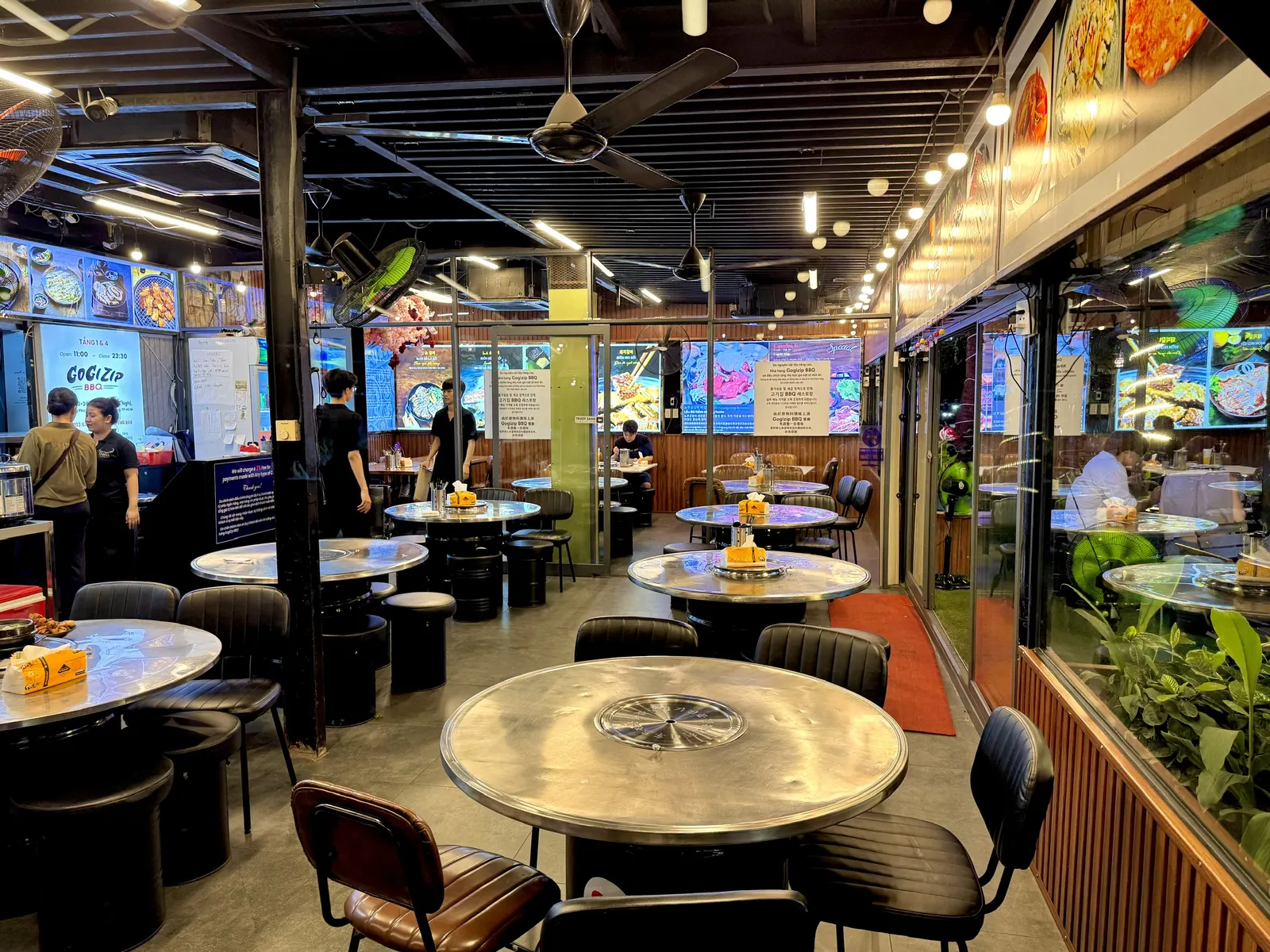
The first time they hold a pair of Korean chopsticks, many Vietnamese diners are surprised: they are made of metal, flat, a bit heavy, and slipperier than familiar bamboo chopsticks. Next to them is a long-handled, thin spoon used for scooping rice and sipping soup. This spoon-and-chopsticks set is more than an eating tool; it reflects the history, habits, and cooking style of Koreans. This article explains why Koreans use metal chopsticks, compares them with Vietnamese, Chinese, and Japanese chopsticks, shows how to hold metal chopsticks, and shares tips for picking up slippery foods such as tofu, glass noodles, and beans during a Korean BBQ meal.
What is the Korean spoon-and-chopsticks set (sujeo)?
Koreans call the set sujeo, a combination of suljeo (spoon) and jeotgarak (chopsticks). At the table, the spoon is used for rice and soupy dishes such as soups and stews; the chopsticks are used to pick up banchan, meat, and vegetables. A Korean spoon usually has a small round bowl and a long straight handle; the chopsticks are about 22–23 cm long, flat, with slightly tapered tips. Both are usually made of stainless steel, and sometimes silver or brass in traditional high-end sets.
Why do Koreans use metal chopsticks?
Historical reasons
Many sources say metal chopsticks date back to ancient dynasties, when kings used silver chopsticks because silver was believed to change color on contact with certain poisons. While this sounds more like legend than scientific evidence, it shows that metal chopsticks have long been associated with the nobility. Later, metal gradually became common among ordinary people as metalworking techniques developed, especially stainless steel.
Practical reasons
- Hygiene: metal is non-absorbent and easy to wash and sanitize.
- Durability: it lasts for years and doesn’t rot like bamboo or wood.
- Heat resistance: well suited to hot soups and grilled dishes.
- Cooking habits: a Korean meal includes many soups and stews, so a spoon is needed alongside chopsticks.
Comparing Korean, Vietnamese, Chinese, and Japanese chopsticks
| Country | Common material | Shape | Length |
|---|---|---|---|
| Korea | Metal (stainless steel) | Flat, slightly tapered tips | Short to medium (~22–23 cm) |
| Vietnam | Bamboo, wood, plastic | Round, slightly small tips | Medium (~24–25 cm) |
| China | Wood, bamboo, plastic | Round, blunt tips | Long (~25–27 cm) |
| Japan | Wood, bamboo, lacquer | Round, very pointed tips | Short (~21–23 cm) |
Korean metal chopsticks are harder to use than wooden ones because the surface is slippery, but in return they are compact and easy to keep clean. Beginners usually need a few minutes to get used to them, after which the motion doesn’t feel very different.
A short history of Korean spoons and chopsticks
The spoon is a very ancient Korean eating utensil, appearing thousands of years ago, and by many archaeological accounts even before chopsticks. Chopsticks were introduced from China and gradually became a common utensil. Over the centuries the shape of spoons and chopsticks changed: during the Joseon period, bronze and silver sets were common in the royal family, while wealthy households used brass ware. Stainless steel became widespread in the 20th century because it is cheap, durable, and easy to keep clean.
Today, metal spoons and chopsticks are a familiar sight in every Korean restaurant and home. Many foreign visitors to Korea bring a set home as a souvenir. A spoon-and-chopsticks set is also a traditional gift for a baby’s first birthday, wishing the child a life of plenty of food and clothing.
Spoons and chopsticks in rituals and daily life
At funerals and ancestral rites, spoons and chopsticks are placed according to special rules, which is why sticking chopsticks upright in a rice bowl is avoided at everyday meals. At weddings, a new set of spoons and chopsticks is often given as a wish for happiness. This shows how an everyday object can carry many cultural meanings.
How to hold metal chopsticks
- Fix the lower chopstick: place it in the gap between your thumb and index finger, resting on your ring finger.
- Hold the upper chopstick with three fingers: thumb, index, and middle finger hold it like a pen.
- Move the upper chopstick: only the upper chopstick moves; the lower one stays still.
- Hold near the middle of the chopsticks: not too close to the tips, for better control.
- Use moderate pressure: pinching too hard tires your hand, too loosely and food drops.
Tips for picking up slippery food with metal chopsticks
- Tofu: scoop it with the spoon instead of picking it up.
- Glass noodles: wind a few strands around the chopsticks like winding noodles, then lift.
- Beans and corn: scoop with the spoon or pick up in small clusters.
- Grilled meat: use the tongs; don’t try to pick up hot meat with chopsticks.
- Large pieces of kimchi: cut them smaller with scissors before picking them up.
Practice metal chopsticks in 5 minutes
If you want to get used to them quickly, try a few simple exercises at home. First, use metal chopsticks to move small items such as beans, paper balls, or firm tofu cubes from one plate to another. Second, practice keeping the lower chopstick steady by using your ring finger as the support point. Third, practice opening and gently closing the upper chopstick to pinch lightly. Just a few minutes a day, and after a few days your hand will feel more flexible.
One piece of advice: don’t grip the chopsticks too tightly, as it tires your hand and makes them hard to control. Let your fingers relax and hold only as firmly as needed. Once you are used to it, metal chopsticks won’t feel as slippery as they did at first.
Choosing metal chopsticks for your family
- Choose moderately thick stainless steel, not too light.
- A surface with small grooves at the tips adds friction.
- A length that suits your hand, not too long.
- Prefer products with food-safety certification.
How to use a Korean spoon
A Korean spoon has a long handle and a shallow round bowl. When scooping rice or sipping soup, hold the spoon like a pen and bring a moderately full spoon to your mouth. Don’t fill it so much that the broth spills. When serving rice to others, use a separate spoon or a shared spoon if available. At formal meals, Koreans usually place the spoon on the right with the chopsticks beside it, the spoon sitting closer in.
Spoons and chopsticks at a Korean BBQ
At a Korean BBQ, chopsticks are used to pick up banchan, vegetables, and cooked meat. Tongs (jipge) are used to place raw meat on the grill and turn it. Scissors (gawi) are used to cut the meat. The spoon is for rice, soup, or steamed eggs. You can revisit our article on Korean dining etiquette for more on chopstick and spoon manners. When dining at Gogizip, if you are not used to metal chopsticks, simply use the tongs and ask the staff for help.
Other tools at a Korean BBQ: tongs, scissors, gloves
Besides spoons and chopsticks, a Korean BBQ meal has other dedicated tools. The tongs (jipge) are long with wide flat tips, used to place meat on the grill and flip it. The scissors (gawi) are large with sturdy blades, used to cut meat, vegetables, and kimchi at the table. Foil or a replacement grill plate is swapped in when it gets burnt. Some restaurants also provide disposable plastic gloves for dishes that need to be eaten by hand, such as spicy chicken feet. See our article on spicy braised chicken feet to learn how to eat this dish.
The important thing is to tell apart the tools for raw meat from the tools for eating. Tongs that have touched raw meat shouldn’t be used to pick up cooked food to put in your mouth. Many restaurants have two separate pairs of tongs, or the staff will change the tongs when needed. If you’re not sure, ask the staff.
How to combine the tools efficiently
- Tongs place raw meat on the grill.
- Scissors cut the meat when it is just about cooked.
- Chopsticks lift the cooked pieces onto a plate or lettuce.
- The spoon scoops rice, soup, or dipping sauce.
Things to avoid with spoons and chopsticks
- Don’t stick chopsticks upright in a bowl of rice.
- Don’t point chopsticks at other people.
- Don’t tap chopsticks on the table or a bowl.
- Don’t hold the spoon and chopsticks in the same hand while eating.
- Don’t stir a bowl of soup with chopsticks.
Tips for beginners with metal spoons and chopsticks
In your first few meals, try using the spoon more than the chopsticks, especially for rice and soup. For side dishes, pick up easy items such as lettuce, bite-size kimchi, and pre-cut meat. For slippery foods like tofu, use the spoon to scoop. If your hand gets tired, rest a moment and continue. Many young people trying Korean food for the first time have become confident with metal chopsticks after just one meal.
You can also bring your own chopsticks if you’re used to bamboo, but at a restaurant, trying the metal spoon-and-chopsticks set is part of the experience. Don’t worry about being judged; staff and fellow diners understand that this is new to many people.
Korean spoons and chopsticks in Vietnamese homes
Many Vietnamese families now buy Korean spoon-and-chopsticks sets for daily use, especially families who love Korean dramas or often cook Korean dishes at home. Metal chopsticks are durable, easy to keep clean, and suit a modern kitchen. The long spoon is great for stirring soup and scooping rice. When using them, wash with hot water and dry thoroughly, and avoid leaving them damp for long, which can cause staining. For young children, choose a set with rounded, safe tips.
Frequently asked questions about Korean spoons and chopsticks
Why are Korean chopsticks made of metal?
Because of historical tradition, durability, easy hygiene, and suitability for the many hot and soupy dishes in Korean meals.
Are metal chopsticks hard to use?
They are a bit slippery at first, but a few tries and you’ll get used to them. You can use a spoon or tongs for foods that are hard to pick up.
What do Koreans eat rice with?
They use a spoon to scoop rice and sip soup; chopsticks are for side dishes.
Can I use chopsticks to pick up grilled meat?
Yes, but use the tongs to place raw meat on the grill and turn it; use chopsticks when eating.
What if I don’t know how to use metal chopsticks?
You can ask the staff for help or use a spoon or fork. Korean restaurants are very relaxed with new guests.
Does Gogizip provide tongs and scissors?
Yes. As at other Korean BBQ restaurants, the staff will help you during the grilling.
Spoons, chopsticks, and the different way of eating rice
The biggest difference between a Vietnamese and a Korean meal is how rice is eaten. Vietnamese diners lift the rice bowl and push rice into the mouth with chopsticks, whereas Koreans leave the bowl on the table and scoop it spoonful by spoonful. There is a practical reason: Korean rice bowls are often metal, hot, and heavy, hard to lift; moreover, Korean rice is sticky and clumpy, so a spoon is more convenient. Once you understand this, you won’t find it strange to see a metal rice bowl with a lid at a Korean restaurant.
At a Korean BBQ restaurant, rice is usually served as a side or to finish the meal. If you order bibimbap or a soup, try using the spoon the Korean way: scoop rice, ladle soup, taste the flavors. You’ll find it a different but enjoyable experience. See our article on bibimbap, Korean mixed rice to learn how to mix and eat bibimbap with a spoon.
Spoon-and-chopsticks gifts: meaning and how to choose
A spoon-and-chopsticks set is a familiar gift in Korean culture. At weddings, a new set may be given to the couple with wishes for happiness. For a housewarming, spoons and chopsticks are a wish that the family will always have plenty. For international friends, a nice Korean spoon-and-chopsticks set is a meaningful and practical present. When choosing, prefer safe materials, simple design, and neat packaging. If you plan to buy one as a gift, look for a set with traditional motifs such as lotus, crane, or water waves.
Conclusion
Korean spoons and chopsticks are small but hold many cultural stories. Try holding metal chopsticks at Gogizip, 93 Pham Van Nghi Street, Phu My Hung Urban Area, Tan Hung Ward, Ho Chi Minh City. Prices exclude 10% VAT.
Craving Korean BBQ? Gogizip BBQ – 93 Pham Van Nghi, Phu My Hung (District 7), open 11:00–23:00 daily. Combos for 2 from 599k VND, for 4 from 1,159k VND (prices before 10% VAT). 9 free banchan, refilled anytime. Some of our staff speak English.