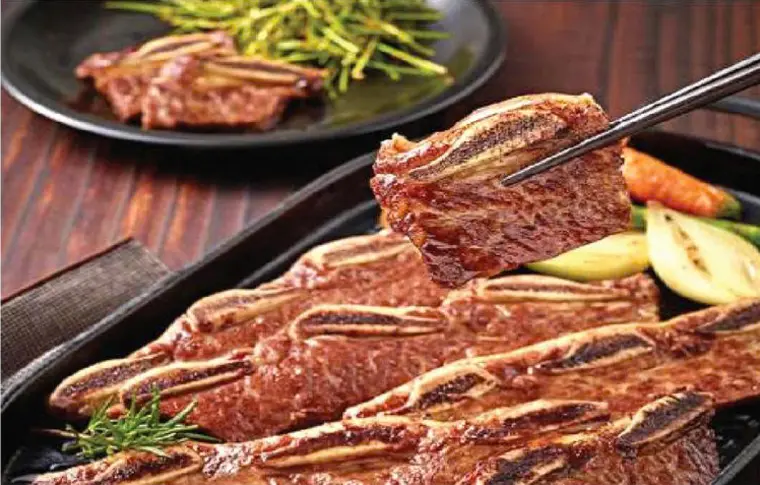
Korea has several “capitals of galbi”, but the most famous of all is Suwon wang galbi (수원왕갈비) – the “king ribs” of Suwon, a city about 30 km from Seoul. The name “wang” (king) comes from the long, wide rib bone, with the meat butterflied thin, rolled up and grilled over charcoal. Let’s find out more with Gogizip.
Why is Suwon famous for beef ribs?
- Suwon once had a huge cattle market: in the 1940s it ranked among Korea’s 3 biggest, peaking in the 1970s before closing in the mid-1990s.
- The busy cattle market drew a whole cluster of beef restaurants around it.
- Locals also link the story to King Jeongjo building Hwaseong Fortress and developing farming in the area (a much-retold legend whose accuracy is unclear).
Hwachunok – where it all began
According to the Korea Tourism Organization, Suwon wang galbi traces back to Hwachunok (화춘옥), a hangover-soup house opened in 1945 next to the cattle market. It became known for putting generous beef ribs in its soup, and gradually moved on to selling grilled ribs. In the 1960s, rumors that the president of the day often dropped by made “Suwon galbi” famous nationwide. When Hwachunok closed, its former cooks opened their own restaurants across the city, creating today’s Suwon “galbi street”.
How is Suwon galbi different from regular marinated ribs?
- Long, large rib pieces: the meat is butterflied into a long thin strip and rolled up – hence the word “wang”.
- Light marinade: traditional Suwon style is seasoned mainly with salt, garlic, sugar and sesame oil rather than lots of soy sauce, to keep the beef flavor front and center.
- Staff usually snip the ribs with scissors right on the grill when they’re nearly done.
How to eat Korean beef ribs
- Grill over medium heat, turning a few times so the marinade doesn’t burn.
- Cut into bite-size pieces and save the meat closest to the bone for last – it’s the best part!
- Wrap in lettuce with garlic and dip in ssamjang or sesame salt.
- Finish with a bowl of cold noodles – the classic combo at Korean galbi houses.
Korean beef ribs in District 7
Gogizip serves marinated LA beef short ribs (sườn bò LA ướp sốt) (LA galbi – ribs cut across the bone, part of the same galbi “family” as Suwon ribs), marinated pork ribs (sườn heo ướp) and cold noodles (mì lạnh) to round off the meal. Read more about Korean BBQ marinades, see the menu or book a table. Hotline 0898 611 611 – 93 Phạm Văn Nghị, Phú Mỹ Hưng.
Frequently asked questions
What does wang galbi mean?
“Wang” means king and “galbi” means ribs – referring to a long, large beef rib with the meat butterflied thin and rolled up.
How is Suwon galbi different from LA galbi?
Suwon galbi uses a long rib with the meat butterflied lengthwise; LA galbi is cut across several rib bones, so each strip has a few small bone pieces.
What goes well with Korean beef ribs?
Lettuce wraps, garlic, ssamjang, banchan and a bowl of cold noodles to finish.
References
- Korea.kr / Korea Tourism Organization – K-local: Suwon wang galbi
- Seoul Shinmun – Suwon galbi and Pocheon galbi
- Money Today (2025) – Suwon galbi
Craving Korean BBQ? Gogizip BBQ – 93 Pham Van Nghi, Phu My Hung (District 7), open 11:00–23:00 daily. Combos for 2 from 599k VND, for 4 from 1,159k VND (prices before 10% VAT). 9 free banchan, refilled anytime. Some of our staff speak English.