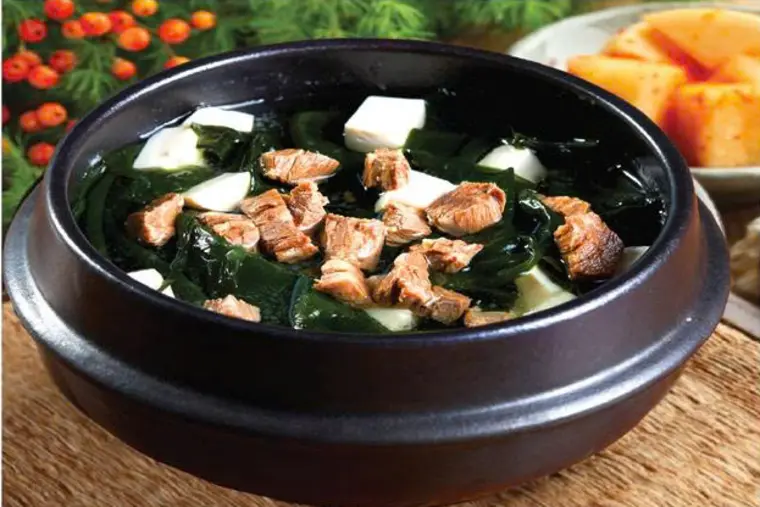
In Korea, a birthday breakfast is not a cake but a steaming bowl of seaweed soup called miyeokguk (미역국). It is a tradition that has lasted for centuries, and many Koreans consider it almost obligatory on a birthday, no matter their age. For Vietnamese readers, the idea of eating soup on your birthday may sound odd, but the reason behind it is deeply moving: it is a way of remembering and thanking the mother who gave birth to you. This article explains the meaning of miyeokguk, other Korean birthday customs such as the doljanchi first-birthday celebration, and how to enjoy seaweed soup.
What is miyeokguk?
Miyeok means seaweed (a kind of wakame), and guk means soup. Korean seaweed soup is made from dried seaweed that has been soaked until it expands, lightly stir-fried with sesame oil, garlic, and beef (or seafood), then simmered in a clear broth seasoned with soy sauce. The flavor is mild and clean, with a gentle sweetness from the beef, the aroma of sesame oil, and the natural taste of the sea.
It is an easy-to-eat soup suitable for all ages and very commonly cooked in Korean households. In daily life it is a familiar soup, but only on a birthday does it take on special meaning.
Why eat seaweed soup on your birthday?
In Korean tradition, women who have just given birth are given seaweed soup for many weeks. Seaweed is rich in iodine, calcium, iron, and fiber, and is believed to help restore strength, promote milk production, and cleanse the body after childbirth. For this reason, seaweed soup is associated with the image of the mother and the moment of birth.
On your birthday, eating seaweed soup is a reminder of how hard your mother worked to bring you into the world and a silent expression of gratitude. Many Korean adults still cook it themselves or ask their mothers to cook seaweed soup on their birthday morning. For a Korean person, skipping this soup on their birthday is sometimes seen as slightly “lacking.” Note that the belief in the benefits of seaweed is folk experience; consult a doctor about postpartum diet.
Miyeok seaweed: a familiar Korean ingredient
Miyeok seaweed (wakame) is a dark green, soft and chewy seaweed that grows in cold waters. Korea is one of the world’s biggest consumers and exporters of seaweed. Besides soup, seaweed is used in salads (miyeok-muchim) dressed sweet and sour, rolled with rice (kimbap), or grilled crisp to eat with rice. Dried seaweed is usually sold in bundles; just soak it in water and it expands many times its size.
Nutritionally, seaweed is rich in fiber, iodine, calcium, and magnesium, and very low in calories. However, because of its high iodine content, it should not be eaten in excess every day, especially by people with thyroid problems. For everyday meals, a bowl of seaweed soup is a light and nourishing choice.
Choosing good seaweed
- Deep blackish-green color, not faded to brown or white.
- Thick, intact strands, not crumbled.
- A light sea smell, not fishy or musty.
- Sealed packaging with a clear expiry date.
How to cook traditional seaweed soup
- Soak the seaweed: soak dried seaweed in cold water for about 20–30 minutes until expanded, rinse well, and cut into pieces.
- Stir-fry briefly: stir-fry the seaweed with sesame oil, minced garlic, and thinly sliced beef.
- Cook the soup: add water, bring to a boil, then lower the heat and simmer for about 30 minutes.
- Season: season with Korean soup soy sauce (guk-ganjang) and a little salt.
- Serve hot: with steamed white rice and kimchi.
There are versions that use seafood instead of beef, such as clams, oysters, or shrimp, giving a stronger sea sweetness. You can revisit our article on Korean soups and stews to learn about other types of soup.
Other Korean birthday customs
Doljanchi – the first birthday celebration
Doljanchi is the celebration of a baby’s first birthday, once a very important occasion because infant mortality used to be high. During the celebration, the baby wears hanbok, sits in front of a table laden with food, and plays doljabi: objects such as thread (symbolizing long life), a brush (being a good student), money (wealth), and a microphone (an entertainer) are placed in front of the baby. The first object the baby picks is believed to predict the future. The table has colorful rice cakes, sticky rice cakes, and fruit.
Rice cakes at birthdays
Baekseolgi (white steamed rice cake) symbolizes purity and health, and is often used at the doljanchi. Sujebi (hand-torn dough soup) and songpyeon also appear depending on the occasion. If you like Korean rice cakes, read our articles on what tokbokki is and cheese rice cakes.
60th birthday – hwangap
In the old days, living to 60 was rare, so hwangap was a major celebration of longevity. Children and grandchildren would hold a feast, bow to wish their parents long life, and offer many dishes. Today, with longer life expectancy, hwangap is simpler, but it is still an occasion for the family to gather.
Modern birthdays
Young Koreans often celebrate birthdays with cake, candles, parties with friends, gifts, and of course seaweed soup at breakfast or lunch. Many couples mark birthdays with a dinner at a restaurant, giving flowers and small gifts.
How are beef seaweed soup and seafood seaweed soup different?
| Aspect | Beef seaweed soup | Seafood seaweed soup |
|---|---|---|
| Flavor | Gentle beef sweetness, rich | Sea sweetness, lighter |
| Best for | Those who like traditional flavors | Seafood lovers |
| Aroma | Sesame oil and beef | Sea aroma, slightly salty |
| Allergies | Lower risk | Be careful if you have a seafood allergy |
The beef version is the classic version for birthdays, while the seafood version has a more pronounced sea flavor. Both are easy to eat, light on the stomach, and go well with rice.
Birthdays at Gogizip
If you want to celebrate your birthday Korean-style, a Korean BBQ meal with friends is a great choice. You can order seaweed soup as a way of telling the cultural story and thanking your mother, followed by grilled meat combos for the whole group to raise a glass. See our dining space to choose a suitable area and our menu to plan ahead. Call hotline 0898 611 611 to reserve a table in advance.
Ideas for a Korean-style birthday
- Birthday breakfast: cook or order a bowl of seaweed soup with rice and a few side dishes.
- Dinner with friends: grilled meat, many shared dishes, and toasts together.
- A letter to Mom: write a few lines of thanks to your mother on your birthday, in the spirit of miyeokguk.
- Gifts: a notebook, flowers, a tea set, a spoon-and-chopsticks set.
- Birthday song: Koreans also sing “saengil chukha hamnida” to a familiar melody.
Bringing Korean customs into a birthday is a fun way to surprise loved ones, especially if they love Korean culture. You don’t need to go overboard; a hot bowl of soup, a sincere greeting, and a happy meal are enough.
Birthday greetings in Korean
- Saengil chukha hamnida (생일 축하합니다): happy birthday.
- Haengbokhan saengil doeseyo (행복한 생일 되세요): wishing you a happy birthday.
- Geonganghaseyo (건강하세요): wishing you good health.
Notes when eating seaweed
Seaweed contains a lot of iodine, so people with thyroid conditions should ask their doctor about how much to eat. Seaweed soup that is too salty is not good for people who need to limit sodium. People with seafood allergies should avoid the seafood version.
Korean birthdays and Vietnamese birthdays: similarities and differences
Both cultures see a birthday as a time to gather, but they express it differently. Vietnamese people usually celebrate with cake, blowing out candles, making wishes, and parties with friends. Koreans have these elements too, with seaweed soup added and, for young children, the doljanchi first-birthday celebration. Many modern Vietnamese families have also begun holding first-birthday parties with a “pick an object” game similar to doljabi, showing cultural crossover.
An important common point is gratitude to parents. In East Asian culture, a birthday is not only your own day but also an occasion to thank those who gave birth to and raised you. Korean seaweed soup is a beautiful symbol of that spirit.
Other dishes at a Korean birthday feast
- Japchae: stir-fried glass noodles with vegetables, symbolizing longevity.
- Gimbap: seaweed rice rolls, easy to share.
- Bulgogi or galbi: grilled beef for the feast.
- Jeon: assorted pan-fried pancakes.
- Rice cakes: symbolizing good luck.
- Seasonal fruit: a light dessert.
You can read our articles on what bulgogi is and Korean grilled beef galbi to choose beef dishes for your birthday feast.
Frequently asked questions about birthday seaweed soup
What is miyeokguk?
It is Korean seaweed soup, usually cooked with beef or seafood and sesame oil.
Why eat seaweed soup on your birthday?
Because the soup is associated with mothers after childbirth; eating it on your birthday is a way of remembering and thanking your mother.
What is doljanchi?
It is the celebration of a Korean baby’s first birthday, with the doljabi game of choosing an object that predicts the future.
Is seaweed soup suitable for children?
Yes, because the flavor is mild and not spicy, but season it lightly and cut the seaweed into small pieces.
Does Gogizip have seaweed soup?
Yes. Gogizip has Beef Seaweed Soup and Seafood Seaweed Soup.
Can I hold a birthday at Gogizip?
Yes. Call hotline 0898 611 611 to reserve a table in advance, especially for a large group.
A bowl of soup, a word of thanks
Imagine your birthday morning beginning with a hot bowl of soup that your mother cooked, or that you cooked yourself to remember her. Even if not everyone is able to live near their mother, a phone call or a thank-you message with a photo of a bowl of soup is enough to make a meaningful moment. The miyeokguk tradition teaches us that a birthday is a day to look back on the journey so far and to honor those who have walked it with us.
If you are in Ho Chi Minh City and want a meaningful evening with loved ones, consider a meal at Gogizip. Order a bowl of seaweed soup and a grilled meat combo, and let the meal become a lovely memory. We are open from 11:00 to 23:00 every day; call 0898 611 611 to reserve a table and ask the staff about your group’s needs.
Conclusion
Birthday seaweed soup is a simple yet profound expression of gratitude. Try it at Gogizip, 93 Pham Van Nghi Street, Phu My Hung Urban Area, Tan Hung Ward, Ho Chi Minh City. Prices exclude 10% VAT.
Craving Korean BBQ? Gogizip BBQ – 93 Pham Van Nghi, Phu My Hung (District 7), open 11:00–23:00 daily. Combos for 2 from 599k VND, for 4 from 1,159k VND (prices before 10% VAT). 9 free banchan, refilled anytime. Some of our staff speak English.