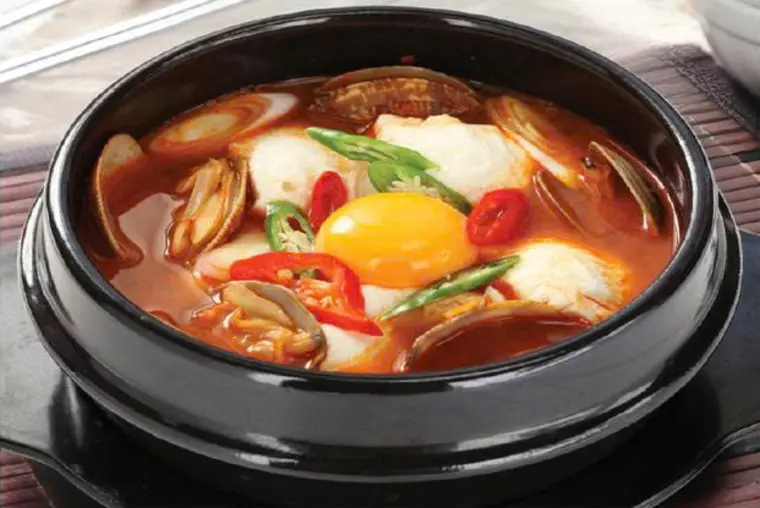
Korean soft tofu stew, or sundubu jjigae, is one of the home-style rice dishes Koreans love most: a small clay pot bubbling away, a warm red spicy broth, and inside it pieces of silken tofu as soft as custard, usually with seafood or meat added. With a bowl of steamed rice it makes a complete meal on its own, but it is also a great dish to share when you go out for Korean BBQ. This article explains what sundubu jjigae is, how silken tofu differs from regular tofu, how to eat it well, and compares the two tofu stews on the Gogizip menu: the spicy seafood tofu stew and the beef tofu stew.
What is sundubu jjigae?
In Korean, “sundubu” means silken tofu (tofu that has not been pressed), and “jjigae” is a type of stew, thicker and more intensely flavoured than an ordinary soup. Put together, sundubu jjigae is a silken tofu stew, usually cooked spicy with Korean chili powder. It is cooked and served in a small clay pot and brought to the table still boiling, so it stays hot for a long time.
In Korea, sundubu jjigae comes in many versions: with seafood such as clams, shrimp and squid; with beef or pork; some places add kimchi or mushrooms. A familiar touch is that many restaurants crack a raw egg into the boiling stew just before you eat. Whatever the variation, the star is always the soft, smooth tofu melting into the warm spicy broth.
If you want to know why Koreans call this dish a jjigae rather than a guk or a tang, our article how jjigae, guk and tang differ explains it in detail.
How is silken tofu different from regular tofu?
Regular tofu is pressed to remove some of its water, so it is firm and can be cut into neat cubes. Silken tofu keeps almost all of its water after it sets, so it is very soft, smooth and fragile, much like Vietnamese tào phớ (soft tofu pudding).
- Texture: silken tofu melts gently in the mouth and barely needs chewing.
- Soaks up the broth: because it is soft and porous, silken tofu absorbs the spice and sweetness of the broth very quickly.
- Balances the heat: the light, mild richness of the tofu softens some of the chili’s intensity.
That contrast between a hot, spicy broth and soft, cooling tofu is exactly why people who have tried this dish tend to get hooked.
Why does sundubu jjigae always come with rice?
For Koreans, a jjigae is almost always eaten with rice. The rich, spicy, slightly thick broth is made to be spooned over rice or eaten alternately with plain steamed rice. A typical sundubu meal is one pot of stew, one bowl of rice and a few banchan such as kimchi and seasoned vegetables.
At Gogizip, every soup and stew on the menu comes with complimentary rice, so one tofu stew is enough for a complete meal for one person, or a shared dish for the table at a BBQ dinner. If you have a big appetite, you can order extra rice (20,000 VND). Learn more about the side dishes in our article what is banchan.
How to enjoy spicy soft tofu stew
- Let it stop boiling for a moment. The pot usually arrives very hot, and silken tofu holds heat for a long time. Ladle some into a small bowl or blow on it before eating so you don’t burn your mouth.
- Scoop the tofu together with the broth. Don’t try to pick the tofu up with chopsticks, as it breaks easily. Use a spoon to take tofu and broth together for the full flavour.
- Alternate with rice. Koreans often take a spoonful of rice, then dip it in or pour a little broth over it, eating in small bites. You can also pour the stew straight into your rice bowl if you like.
- Use banchan to change the taste. A bite of kimchi or seasoned vegetables between spoonfuls cools your mouth and lets you taste the broth more clearly.
- If it feels too spicy, eat more rice with it. Steamed rice and steamed egg are two very effective helpers for calming the heat. Gulping cold water usually does not help as much.
Spicy seafood tofu stew or beef tofu stew?
The Gogizip menu has two tofu stews, both priced at 180,000 VND and both served with complimentary rice. Which one to choose depends on your taste:
Spicy seafood tofu stew – 180,000 VND
The spicy seafood tofu stew (canh đậu hủ hải sản cay, haemul sundubu jjigae) is the version closest to the classic image of sundubu jjigae: as the name says, it combines tofu, seafood and spice. Typically, the natural sweetness of the seafood blends into the spicy broth for a fresh, rich flavour. It suits people who like spicy food, love seafood, or want a soupy dish to wake up the palate after a few rounds of rich grilled meat.
Beef tofu stew – 180,000 VND
The beef tofu stew (canh đậu hủ thịt bò) is for those who prefer the taste of beef to seafood. It is a good choice when someone at the table doesn’t eat seafood, or when you want a more filling stew.
Quick guide
- Love seafood and spice: spicy seafood tofu stew.
- Don’t eat seafood, prefer beef: beef tofu stew.
- Two of you and want to try both: order one of each and swap bowls.
If you’re still unsure about the spice level, ask our staff when ordering. For those who don’t eat spicy food at all, beef seaweed soup (canh rong biển thịt bò) (160,000 VND) or beef short rib soup (súp sườn bò) (230,000 VND) are lighter options.
Other seafood soups and stews on the menu
If you love seafood and want a change, the menu also has:
- Seafood kimchi stew (canh kimchi hải sản) – 180,000 VND: the signature sour-spicy taste of kimchi, for those who like bold flavours.
- Seafood soybean paste stew (canh tương đậu hải sản) – 180,000 VND: the savoury, nutty flavour of fermented soybean paste.
- Seafood seaweed soup (canh rong biển hải sản) – 170,000 VND: light and clean, not spicy.
All soups and stews come with complimentary rice; prices exclude 10% VAT.
Ordering suggestions
A quick lunch for 2
We open at 11:00, which makes it very convenient for lunch. A simple suggestion:
- Spicy seafood tofu stew (with rice): 180,000 VND
- Beef tofu stew (with rice): 180,000 VND
- Steamed egg (trứng hấp): 90,000 VND
- Seafood and green onion pancake (bánh xèo hành lá hải sản): 220,000 VND
Total: 670,000 VND, excluding 10% VAT (about 737,000 VND with VAT). The soft, smooth steamed egg is a great rescue when the stew is spicy; you can read more about it in our article on gyeran-jjim, Korean steamed egg.
Adding it to a BBQ meal
At a Korean BBQ dinner, a pot of spicy tofu stew helps balance the richness. Example for 2: Combo E (1,199,000 VND, 500g: 150g chuck flap, 150g US beef brisket, 100g rib finger meat, 100g US beef skirt; our best-selling combo) plus one spicy seafood tofu stew (180,000 VND). Total 1,379,000 VND, excluding 10% VAT (about 1,517,000 VND with VAT).
A small tip: order the stew once the first round of meat has been grilled. By then you’ll be starting to feel the richness, and a spoonful of hot, spicy stew will make the rest of the meal taste even better. Read our article what to know before your first Korean BBQ for a sensible ordering sequence.
Come to Gogizip for spicy soft tofu stew
Gogizip BBQ is a charcoal-grill Korean BBQ restaurant in Phu My Hung, open 11:00–23:00 every day. You can choose the outdoor area, the open air-conditioned area or the enclosed air-conditioned room (non-smoking); have a look first on our space page. Book a table on 0898 611 611 (call or Zalo) or through our booking page. Cars can park free in front of the restaurant; motorbikes can use the parking lot opposite (East Gate 2 of the Garden apartment building). If you’d rather eat at home, we deliver via Grab. The full menu in four languages, Korean, Chinese, Vietnamese and English, is on our menu page, and common questions are answered on our FAQ page.
Frequently asked questions about Korean soft tofu stew
What is sundubu jjigae?
Sundubu jjigae is a Korean silken tofu stew, usually cooked spicy with Korean chili powder, with seafood or meat added, served in a hot clay pot and eaten with steamed rice.
How is silken tofu different from regular tofu?
Silken tofu is not pressed to remove water, so it is very soft, smooth and fragile, similar to soft tofu pudding. That is why it absorbs the broth quickly and seems to melt in your mouth.
Do the tofu stews at Gogizip come with rice?
Yes. Soups and stews at Gogizip, including the spicy seafood tofu stew and the beef tofu stew, all come with complimentary rice. If you need more, extra rice is 20,000 VND.
Should I choose the spicy seafood tofu stew or the beef tofu stew?
Choose the spicy seafood tofu stew if you like seafood and spice; choose the beef tofu stew if you don’t eat seafood or prefer the taste of beef. Both cost 180,000 VND, excluding 10% VAT.
What if the tofu stew is too spicy for me?
Eat it with more steamed rice, order a soft steamed egg and alternate with banchan. If you’re worried about the spice level, ask our staff when ordering.
I don’t eat spicy food. Which soup can I have instead?
You can choose the beef seaweed soup, the seafood seaweed soup or the beef short rib soup; these are the light, non-spicy soups on the menu.
Conclusion
Korean soft tofu stew is warming, easy to eat and perfect with rice: soft, smooth silken tofu, a hot spicy broth, and with rice and banchan it is a full meal. Whether you choose the spicy seafood version or the beef version, try taking each spoonful of tofu and broth together with rice to get the full flavour. Visit Gogizip at 93 Pham Van Nghi Street, Phu My Hung Urban Area, Tan Hung Ward, Ho Chi Minh City. Prices exclude 10% VAT.
Craving Korean BBQ? Gogizip BBQ – 93 Pham Van Nghi, Phu My Hung (District 7), open 11:00–23:00 daily. Combos for 2 from 599k VND, for 4 from 1,159k VND (prices before 10% VAT). 9 free banchan, refilled anytime. Some of our staff speak English.