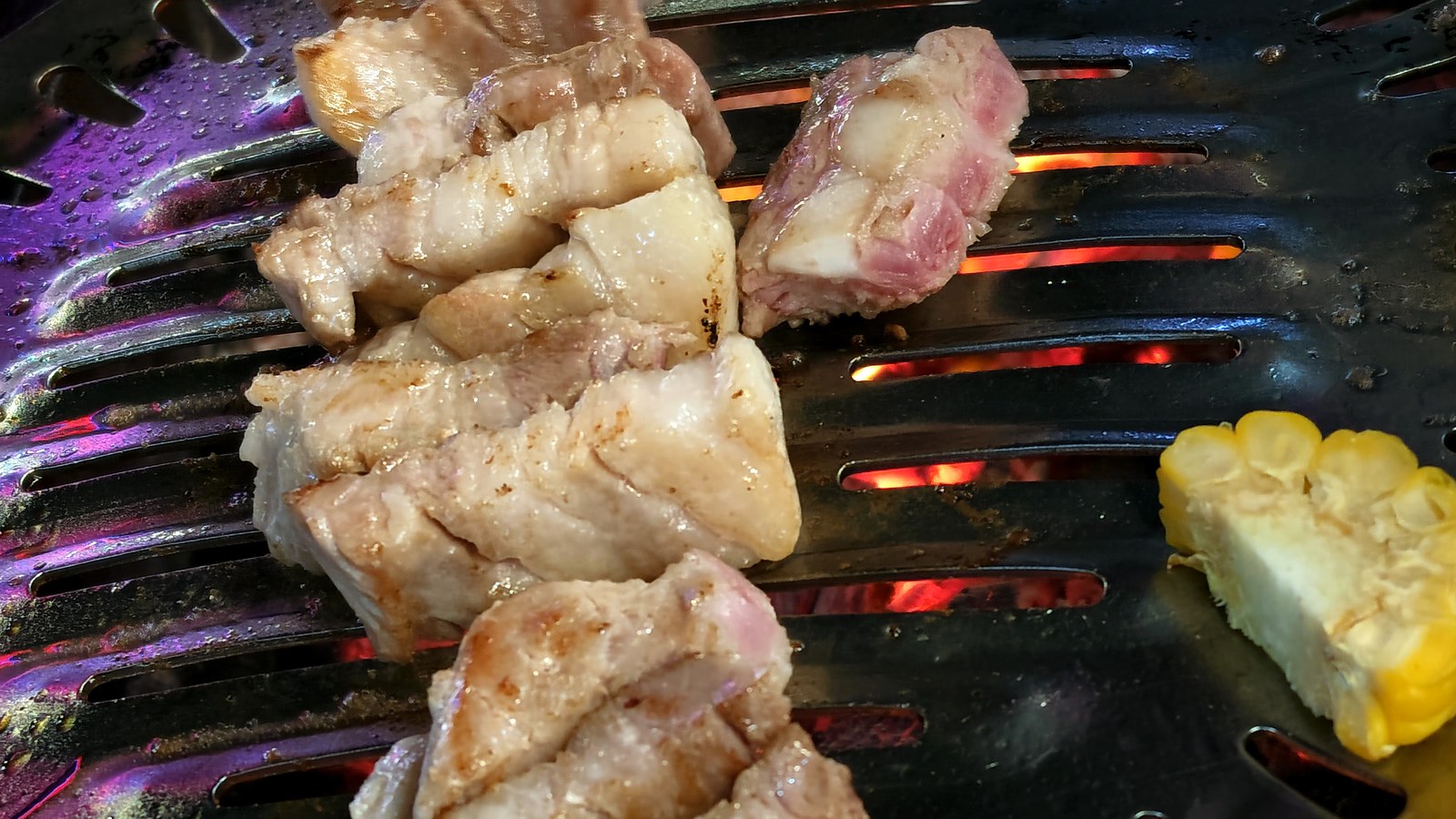
Visitors to Jeju Island (Korea) usually have two “must-dos”: gazing at the sea and eating grilled black pork – heukdwaeji (흑돼지). Jeju City even has a whole “black pork street” lined with BBQ restaurants. So why is this pig breed so famous?
A breed with thousands of years of history
According to the Korea Cultural Heritage Administration, black pig farming on Jeju is recorded in ancient texts such as the Records of the Three Kingdoms (3rd century). Because Jeju is an island cut off from the mainland, its black pigs kept their own distinctive traits: small ears that stand upright (mainland black pigs have large ears that point forward), a sturdy body and good adaptation to the island climate.
Black pork is also woven into everyday life on Jeju: pork is always served at weddings and memorial rites, and dishes such as dombe-gogi (boiled pork sliced on a wooden board), Jeju-style blood sausage and pork noodle soup (gogi-guksu) are all island specialities.
From near extinction to “natural monument”
During the 20th century, crossbreeding with higher-yield foreign breeds caused purebred black pigs to decline sharply. In 1986, the Jeju Livestock Development Institute found 5 purebred native pigs on the small island of Udo and began a breeding programme. In March 2015, the institute’s purebred herd of about 260 pigs was designated Natural Monument No. 550 of Korea.
A fun fact: the “Jeju black pork” sold in restaurants comes from commercial herds (crossbred black pigs raised longer than ordinary pigs), not from the protected purebred herd.
How to eat grilled black pork the Jeju way
- The meat is cut into very thick pieces, grilled over charcoal and often served with the skin still on.
- Dip it in Jeju-style anchovy sauce (melj-jeot) heated right on the grill – a signature of the island.
- Eat it with grilled garlic, kimchi and lettuce wraps, just like samgyeopsal on the mainland.
Korean charcoal-grilled pork in Phu My Hung
No trip to Jeju on the horizon? At Gogizip BBQ (93 Pham Van Nghi, Phu My Hung, District 7) you can enjoy Korean-style charcoal-grilled pork cuts: pork belly (ba chỉ heo, samgyeopsal), pork collar (cổ heo, moksal), pork jowl (nọng heo, hangjeongsal), pork skin (da heo) and marinated pork ribs (sườn heo ướp) – grilled at your table, served with lettuce wraps and 9 free banchan. (Gogizip does not serve Jeju black pork.)
- How do the cuts of Korean grilled pork differ?
- Pork jowl (hangjeongsal)
- How do Koreans eat samgyeopsal?
Frequently asked questions
How is Jeju black pork different from ordinary pork?
Jeju black pigs have black hair and small upright ears, and are usually raised longer than ordinary pigs; the meat is praised as firm, rich and fragrant. The protected purebred herd has been Korea’s Natural Monument No. 550 since 2015.
What do you dip Jeju black pork in?
The signature dip is Jeju-style anchovy sauce heated on the grill; you can also use sesame salt or ssamjang and wrap it in greens like other Korean grilled meats.
Sources (in Korean)
- Bizhankook – Cultural Heritage Administration announces designation of Jeju black pigs
- Invest Korea Jeju – Jeju’s pig farming industry
- Seoul Shinmun – 3 signature meat dishes of Jeju
Craving Korean BBQ? Gogizip BBQ – 93 Pham Van Nghi, Phu My Hung (District 7), open 11:00–23:00 daily. Combos for 2 from 599k VND, for 4 from 1,159k VND (prices before 10% VAT). 9 free banchan, refilled anytime. Some of our staff speak English.