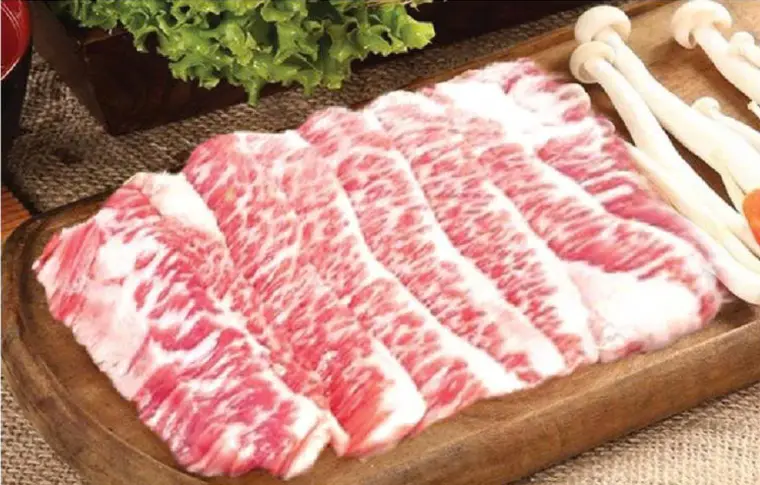
Many people trying Korean BBQ for the first time order pork belly, and only on their second or third visit do they “discover” Korean pork jowl. Koreans call this cut hangjeongsal (항정살): a small piece of meat where fat and lean are interlaced in fine marbling, grilling up crunchy and springy with a satisfying snap in every bite. Because each pig has only a small amount, pork jowl is usually considered a “special” pork cut at BBQ restaurants. This article explains which part pork jowl is, why it is rare, how to grill it golden and crisp, what to dip it in, and how it compares with pork belly so you can choose the cut you’ll enjoy most.
Which part is pork jowl?
Pork jowl is the meat from the cheek and neck area, extending down beneath the pig’s jaw. These muscles work constantly as the pig eats and moves its head, so the meat is firm in texture and wrapped in thin, alternating layers of fat. When sliced, a piece of jowl is pale pink with dense white marbling like a pattern, quite different from the distinct lean and fat layers of pork belly.
In Korean, hangjeongsal is the name commonly used on BBQ menus. In Vietnam, this cut is usually called nọng heo, thịt má heo (pork cheek) or “thịt cổ nọng”. Whatever the name, the shared hallmark is its very distinctive crunchy, springy texture when grilled.
Characteristics of pork jowl
- Fine, even marbling: the fat doesn’t form thick layers but is scattered throughout the meat.
- Crunchy and springy: grilled golden, the meat has a characteristic crisp-chewy texture that gets more fragrant the more you chew.
- Rich but not heavy: thanks to the dispersed fat, jowl is lightly rich rather than “swimming in fat”.
- Small, thin pieces: jowl is usually cut into medium slices and grills fairly quickly.
Why is pork jowl considered a rare cut?
The main reason is quantity. The cheek and neck below the jaw are only a small area of the pig’s body. After removing the skin, sinew and unusable parts, the amount of grillable jowl from each pig is very small compared with the belly, shoulder or leg. In Korea, pork jowl is therefore usually priced higher than pork belly and seen as a cut “for those in the know”.
The second reason is texture. Few pork cuts are rich, crunchy and springy all at once like jowl. Many people used to pork belly find jowl a completely different experience, especially the crunch when you bite into it.
How to grill pork jowl golden and crisp
Pork jowl is fairly “forgiving” because its marbling keeps the meat from drying out quickly. Still, for the best crunch, keep a few points in mind:
- The grill must be hot: jowl needs enough heat for the outside to sear and brown quickly. Put the meat on once the grill is evenly hot.
- Lay the pieces flat: let the whole surface touch the grill so it cooks and crisps evenly.
- Wait for the underside to turn golden before flipping: usually about one to two minutes depending on thickness and how hot the charcoal is. Flip too early and the meat will stick and won’t crisp.
- Grill the other side: until both sides are glossy golden and the fat in the meat turns translucent.
- Cut into bite-sized pieces: use scissors to cut it small, then press the cut sides lightly on the grill so they cook evenly.
- Eat it while hot: pork jowl loses its crunch as it cools, so grill only as much as you’ll eat each round.
Pork must be cooked through, never eaten rare. An easy sign is that the meat is no longer pink in the middle and the juices run clear. You can read more tips on heat, grilling order and using the scissors in our article what to know before your first Korean BBQ.
Common mistakes
- Grilling too long: jowl turns hard and chewy, losing its juicy crunch.
- Flipping constantly: the surface never gets a chance to brown, and the meat is less fragrant.
- Crowding the grill: the heat drops, the meat releases liquid and ends up “boiled” instead of grilled.
What to dip and wrap pork jowl with
Because jowl is lightly rich and crunchy, simple dips bring out the flavor of the meat best:
- Sesame salt or salted sesame oil: the classic dip for Korean-style grilled pork.
- Ssamjang: a bold, slightly spicy dipping paste, great when wrapping with greens. See our article what is ssamjang.
- Wrap in greens: lettuce, perilla leaf, sliced garlic and a little kimchi. The proper way to wrap is in our article ssam: wrapping grilled meat in lettuce and perilla leaves.
- Lightly sour banchan: pickled onions and pickles make each bite feel “lighter”. Read more in what is banchan.
Pork jowl or pork belly: which should you choose?
Pork belly (samgyeopsal) is the “national favorite” of Korean BBQ, while pork jowl is for those who want to explore. Putting them side by side makes the choice easier:
Texture
Pork belly has clearly stacked layers of lean and fat, grilling up tender and rich with a lightly crisp outer layer of fat. Pork jowl has fine fat woven through the meat, grilling up crunchy and springy with a bouncy texture.
Richness
Pork belly is usually richer because of its thick fat layers. Jowl is moderately rich and feels “lighter” when you eat a lot of it.
Prices at Gogizip
Pork belly (ba chỉ heo) is 179,000 VND/160g, and Korean pork jowl is 299,000 VND/160g (not including 10% VAT).
Who each one suits
- Choose pork belly if you like rich, tender meat, are trying Korean BBQ for the first time, or want to save money.
- Choose pork jowl if you like crunchy textures, want to try a “special” cut, or are used to pork belly and want a change.
To compare with other cuts such as pork collar or pork ribs, our article Korean BBQ pork cuts explains them in detail. And if you want to enjoy pork belly the proper way, see what is samgyeopsal.
Ordering pork jowl at Gogizip
- Order Korean pork jowl à la carte: 299,000 VND/160g.
- Combo A (2 people, 599,000 VND, 400g): 150g pork belly, 150g pork collar (thịt cổ heo), 100g pork jowl, plus a complimentary Tokbokki. The easiest way to try both jowl and belly in one meal.
- Combo B (4 people, 1,159,000 VND, 800g): double Combo A, which means 200g of pork jowl, with 1 Tokbokki.
Sample order for two jowl lovers
Combo A (599,000 VND) + 1 extra portion of Korean pork jowl (299,000 VND) + 2 Coke/Sprite (2 × 30,000 = 60,000 VND): a total of 958,000 VND, not including 10% VAT; about 1,054,000 VND with VAT. The two of you will have 260g of pork jowl in total, along with pork belly, pork collar and the complimentary Tokbokki.
Sample order for a group of four
Combo B (1,159,000 VND) + 1 Kimchi soup (canh kimchi) (160,000 VND, comes with rice) + 1 Sapporo draft beer tower 2.5L (320,000 VND): a total of 1,639,000 VND, not including 10% VAT; about 1,803,000 VND with VAT. Remember not to drive after drinking beer.
See all dishes on our menu page. Book ahead via the booking page or call/Zalo 0898 611 611. Gogizip has an outdoor area, an open air-conditioned area and an enclosed air-conditioned non-smoking room; see photos on our space page.
Frequently asked questions about Korean pork jowl
Which part is pork jowl?
Pork jowl is the meat from the cheek and neck area below the pig’s jaw, which Koreans call hangjeongsal. It has fine marbling and grills up crunchy and springy.
Why is pork jowl more expensive than pork belly?
Because the cheek and neck below the jaw are only a small area, each pig yields very little jowl compared with belly, while its crunchy, rich texture is loved by many people.
How long should pork jowl be grilled?
Usually about one to two minutes per side on a hot grill, depending on thickness, until both sides are golden and crisp and the meat is cooked through with no pink in the middle.
What is the best dip for pork jowl?
Sesame salt or salted sesame oil to keep the flavor of the meat, or wrap it in lettuce and perilla leaf with garlic and ssamjang. Lightly sour banchan help cut the richness.
How does pork jowl differ from pork belly?
Pork belly has stacked layers of lean and fat, and is more tender and richer. Pork jowl has fine fat woven through the meat, and is crunchy, springy and moderately rich.
How much is pork jowl at Gogizip?
Korean pork jowl à la carte is 299,000 VND/160g, not including 10% VAT. Combo A includes 100g of pork jowl and Combo B includes 200g.
Conclusion
Korean pork jowl is a small cut that “packs a punch”: crunchy, springy, moderately rich and fragrant when grilled golden. If you’re used to pork belly, try jowl to discover how much more grilled pork has to offer. The easiest way is to order Combo A and try both in one meal. See you at Gogizip, 93 Pham Van Nghi Street, Phu My Hung Urban Area, Tan Hung Ward, Ho Chi Minh City. Open 11:00–23:00, bookings 0898 611 611. Prices do not include 10% VAT.
Craving Korean BBQ? Gogizip BBQ – 93 Pham Van Nghi, Phu My Hung (District 7), open 11:00–23:00 daily. Combos for 2 from 599k VND, for 4 from 1,159k VND (prices before 10% VAT). 9 free banchan, refilled anytime. Some of our staff speak English.
Comments
One response to “Korean Pork Jowl (Hangjeongsal): The Crunchy Cut Each Pig Has Only a Little Of”
[…] Pork jowl (hangjeongsal): crunchy, cooks fast, great with sesame-oil salt. See Korean pork jowl. […]