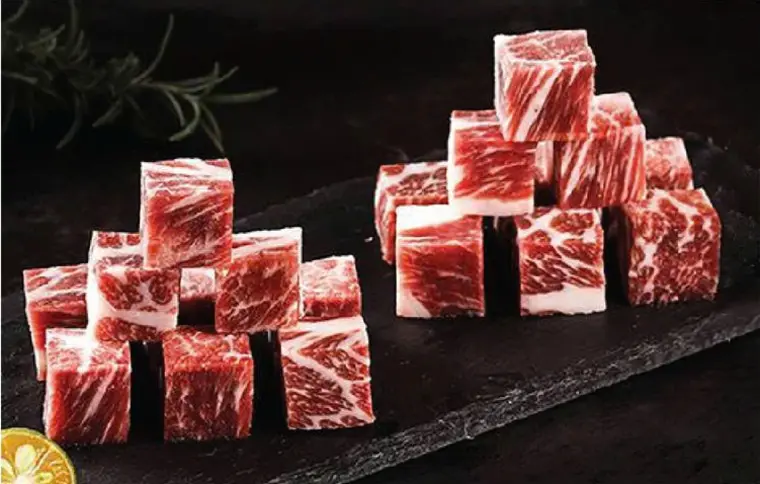
Grilled navel end brisket is a dish for people who love a clear, beefy flavour and a bit of springiness when they chew, rather than meat that melts away. The cut is lean with a little fat and thin sinew running through it. Grilled quickly over glowing charcoal, it turns fragrant, sweet and pleasantly crunchy-chewy; but leave it a few dozen seconds too long and it shrinks and turns tough. So whether this dish is delicious depends heavily on how you grill it. This article explains which part of the cow the navel end brisket comes from, why it gets tough when overcooked, how to grill it just right, why it pairs so well with chili salt, and what to order with it for a complete meal.
Which part of the cow is đuôi gầu?
In Vietnamese, gầu usually refers to meat from the chest and front belly of the cow, where lean fibres are interlaced with thin layers of fat. Many people know gầu from the rich, crunchy “phở gầu”. Đuôi gầu (“the tail of the gầu”) is usually understood as the far end of the gầu piece, where the meat gradually becomes leaner but still has streaks of fat and membrane running through it.
That structure gives navel end brisket its character on the grill:
- Deep beef flavour: the lean meat comes from a hard-working area, so it tastes distinctly beefy, not bland like some very tender cuts.
- Rich but not heavy: there is just enough marbling to release a lovely aroma over the fire, but much less fat than beef brisket (ba chỉ bò).
- Crunchy-chewy texture: the thin sinew, when cooked just right, gives a light crunch and springiness – quite different from the juicy tenderness of chuck flap or skirt.
If you have tried Korean-style grilled beef cuts such as brisket, chuck flap and rib finger meat, navel end brisket sits “in between”: not as thin and quick to melt as brisket, not as juicy-tender as skirt, but with a personality of its own in the chew. For a clearer comparison of the beef cuts, read our article Korean grilled beef: galbi, LA galbi and US beef cuts.
Why does navel end brisket get tough if grilled too long?
This is the most important question for this dish. There are three main reasons:
Muscle fibres contract strongly when overheated
As beef heats up, the muscle fibres contract and squeeze out moisture. When it is just cooked, the meat still holds most of its juices, so it stays tender and sweet. Grilled too long, the fibres contract fully, almost all the moisture escapes, and the meat becomes dry and firm. With a lean, fibrous cut like navel end brisket, this effect is very noticeable.
Sinew needs a long time to soften
Connective tissue (sinew, membrane) only becomes truly tender after long cooking at moderate temperatures, as in braising or simmering. Charcoal grilling is fast cooking, so the goal is not to make the sinew meltingly soft but to keep it pleasantly crunchy. If you keep grilling in the hope that the sinew will soften, the result is usually the opposite: tougher sinew and drier meat.
Thin slices cook very fast
Meat grilled at the table is usually cut into bite-size pieces, so a moment of distraction in conversation is enough to overcook it. Many people are used to grilling pork thoroughly and unconsciously treat beef the same way – and that is when navel end brisket loses its appeal.
How to grill navel end brisket so it is tender, fragrant and not tough
- Get the grill really hot before adding the meat. Beef needs strong heat so the surface sears quickly, creating aroma and locking in the juices.
- Grill a little at a time. Cook only a few pieces per round, just enough for everyone to eat straight away. Don’t cover the whole grill and leave the meat waiting.
- Flip once, not constantly. When the underside has changed colour and has grill marks, turn it over. For thin pieces, each side usually needs only about half a minute to a minute, depending on thickness and how hot the charcoal is.
- Eat it while still slightly pink inside. Navel end brisket is best between medium-rare and medium. If you are not used to rare meat, grill it a little longer, but don’t wait until the meat turns completely grey.
- Cut across the grain if the pieces are large. Use scissors to cut the meat into small pieces, perpendicular to the grain. Shorter fibres make the meat much easier to chew.
- Move it to the edge of the grill once cooked. The edge is cooler and keeps the meat warm without cooking it further too quickly. Best of all, though, is to take it off and eat it right away.
- Don’t press the meat onto the grill. Pressing it with tongs squeezes out the juices and dries the meat faster.
A small tip: let one person be the “grill keeper” for the beef. They just need to focus on the heat and take the meat off at the right moment, and the whole table gets the best bites.
Why does navel end brisket go so well with chili salt?
The dish’s name, “chili salt grilled navel end brisket”, already hints at how to enjoy it: simple salty and spicy flavours instead of a heavy sweet sauce. There are several reasons this suits a cut with a pronounced beef flavour:
- Salt brings out the natural sweetness of the meat. With flavourful beef cuts, people usually prefer minimal seasoning so the charcoal-grilled aroma isn’t masked.
- Heat balances the fat. A touch of spiciness makes each piece feel less rich, so you can eat more without feeling heavy.
- It doesn’t burn as easily as a sweet marinade. Marinades containing sugar scorch easily over high heat, while navel end brisket needs strong heat and quick grilling. Chili salt suits this way of grilling.
In Korea, unmarinated grilled beef is also often dipped in sesame oil mixed with salt and pepper, in the same “keep it simple to honour the meat” spirit. You can also switch things up after a few bites with lettuce wraps, garlic and dipping paste. See how to wrap in our article ssam – wrapping grilled meat and learn about ssamjang.
Navel end brisket compared with the other beef cuts on the menu
If you are deciding between the beef dishes, here is a quick overview by texture and price (prices do not include VAT 10%):
- US beef brisket (ba chỉ bò Mỹ) – 229k/160gr: thinly sliced, rich, cooks extremely fast, great wrapped in greens.
- Chili salt grilled navel end brisket – 290k/160gr: deep beef flavour, crunchy-chewy, for those who enjoy a good chew.
- US rib finger meat (dẻ sườn bò Mỹ) – 329k/160gr: visible marbling, rich and fragrant, more tender.
- US chuck flap (lõi vai bò Mỹ) – 369k/160gr: tender, deep beef flavour, with a line of sinew through the middle.
- US skirt (diềm bò Mỹ) – 469k/160gr: juicy and tender, full of meat juices.
- Marinated L.A. beef short ribs (sườn bò L.A ướp sốt) – 399k/250gr (2 pieces): sweet-savoury marinade, needs medium heat because it burns easily.
Navel end brisket is a sensible choice when you want an extra beef dish with character at a still-friendly price, or when the table already has a combo and you want a different texture to keep the meal interesting.
What to order with grilled navel end brisket
A soup to balance it out
Grilled beef is much more comfortable with a hot soup. Soft tofu soup with beef (canh đậu hủ thịt bò) (180k) or beef seaweed soup (canh rong biển thịt bò) (160k) both come with free rice. If you want something cold to “cool down” after grilled meat, cold noodles in broth (mì lạnh nước, mul-naengmyeon) (150k) is a familiar Korean choice.
Banchan and greens
Kimchi, lettuce, onion and garlic help refresh the palate between bites of meat. If you are new to Korean side dishes, our article what is banchan will walk you through each one.
Drinks
The salty-spicy kick of chili salt goes really well with cold beer (Tiger/Heineken 40k, Sapporo draught 50k per glass) or soju (130k). Please drink responsibly and don’t drive after drinking alcohol.
Sample order for 2 people
A light option focused on beef:
- Chili salt grilled navel end brisket 160gr: 290,000 VND
- US beef brisket 160gr: 229,000 VND
- Soft tofu soup with beef (free rice): 180,000 VND
- Cold noodles in broth: 150,000 VND
- 2 cans of Tiger: 80,000 VND
Total: 929,000 VND, VAT 10% not included (about 1,022,000 VND with VAT).
A more filling option: Combo C for 2 people (899,000 VND, 500gr: 100gr rib finger meat, 150gr US beef brisket, 250gr marinated L.A. beef short ribs, plus 1 free steamed egg) with navel end brisket added (290,000 VND) for another texture. Total 1,189,000 VND, VAT 10% not included (about 1,308,000 VND with VAT).
When ordering several beef dishes, grill them in this order: unmarinated cuts first (brisket, navel end brisket, rib finger meat), marinated cuts last, so the sauce doesn’t burn onto the grill and flavour the other dishes.
Before you visit Gogizip
Gogizip BBQ is a Korean charcoal BBQ restaurant in Phu My Hung, open 11:00–23:00 every day. There is an outdoor area, an open air-conditioned area and enclosed air-conditioned rooms (non-smoking); you can preview them on our space page. Book via 0898 611 611 (call or Zalo) or our booking page; groups of up to 8 should book ahead. Cars park free in front of the restaurant, and motorbikes can use the car park opposite (East Gate 2 of the Garden apartments). The menu is available in four languages – Korean, Chinese, Vietnamese and English; see the full menu.
Frequently asked questions about grilled navel end brisket
Which part of the cow is navel end brisket (đuôi gầu bò)?
Gầu usually refers to meat from the chest and front belly of the cow, where lean meat is layered with thin fat. Đuôi gầu is generally understood as the end section of the gầu, leaner and with membrane running through it, so it grills up with a deep beef flavour and a crunchy-chewy texture.
Why does grilled navel end brisket often turn tough?
When grilled too long, the muscle fibres contract and lose moisture, while the sinew only softens with long, braise-style cooking. That is why navel end brisket needs strong heat, quick grilling and should be eaten as soon as it is just cooked.
How long should navel end brisket be grilled?
For thin pieces, each side usually needs only about half a minute to a minute on a really hot grill, depending on thickness and how hot the charcoal is. Flip once and eat it while the inside is still slightly pink.
Why does navel end brisket pair well with chili salt?
Salt brings out the natural sweetness of the beef, the heat balances the fat, and this way of eating doesn’t burn as easily as a sweet marinade over high heat.
How much is chili salt grilled navel end brisket at Gogizip?
Chili salt grilled navel end brisket at Gogizip is 290,000 VND for 160gr, VAT 10% not included.
What should I order with grilled navel end brisket?
You can add US beef brisket or Combo C, a soup such as soft tofu soup with beef or beef seaweed soup (free rice), and cold noodles in broth to balance the flavours.
Conclusion
Grilled navel end brisket is for people who love a deep beef flavour and a crunchy-chewy bite. The secret is simple: a really hot grill, a little at a time, flip once, cut across the grain and eat as soon as it is just right, dipped in chili salt to bring out the flavour of the meat. Try it with a hot soup and cold noodles at Gogizip, 93 Pham Van Nghi Street, Phu My Hung Urban Area, Tan Hung, Ho Chi Minh City. Prices do not include VAT 10%.
Craving Korean BBQ? Gogizip BBQ – 93 Pham Van Nghi, Phu My Hung (District 7), open 11:00–23:00 daily. Combos for 2 from 599k VND, for 4 from 1,159k VND (prices before 10% VAT). 9 free banchan, refilled anytime. Some of our staff speak English.